Most of this week was spent in Andalucía – aka southern Spain (not to be confused with Andalasia. We definitely did not turn into cartoon versions of ourselves). And yes, Kyle, the sun is indeed hotter in the south of Spain. Specifically we were in Córdoba, Sevilla, and Granada. The name Andalucía comes from Al-Andalus, the name of the Iberian Peninsula during the rule of the musulmanes (Muslims). They governed from the south so that name has stuck with the southern region. I love, love, love this region because of all the examples of Islamic architecture and art, which I also happen to love. The details and complexities are stunning, and I could look at it all day.
On our way to Córdoba, which is about six hours from Madrid, we stopped at a couple sites in the region of La Mancha, home of señor Don Quijote. We saw the famous molinos (windmills) that he believes are giants and tries to fight, and the place where he serenades his love, Dulcinea. This book is still on my ‘to read’ list, but now I’ll be able to visualize the places when I read it.

 |
| Fighting the "giant." |
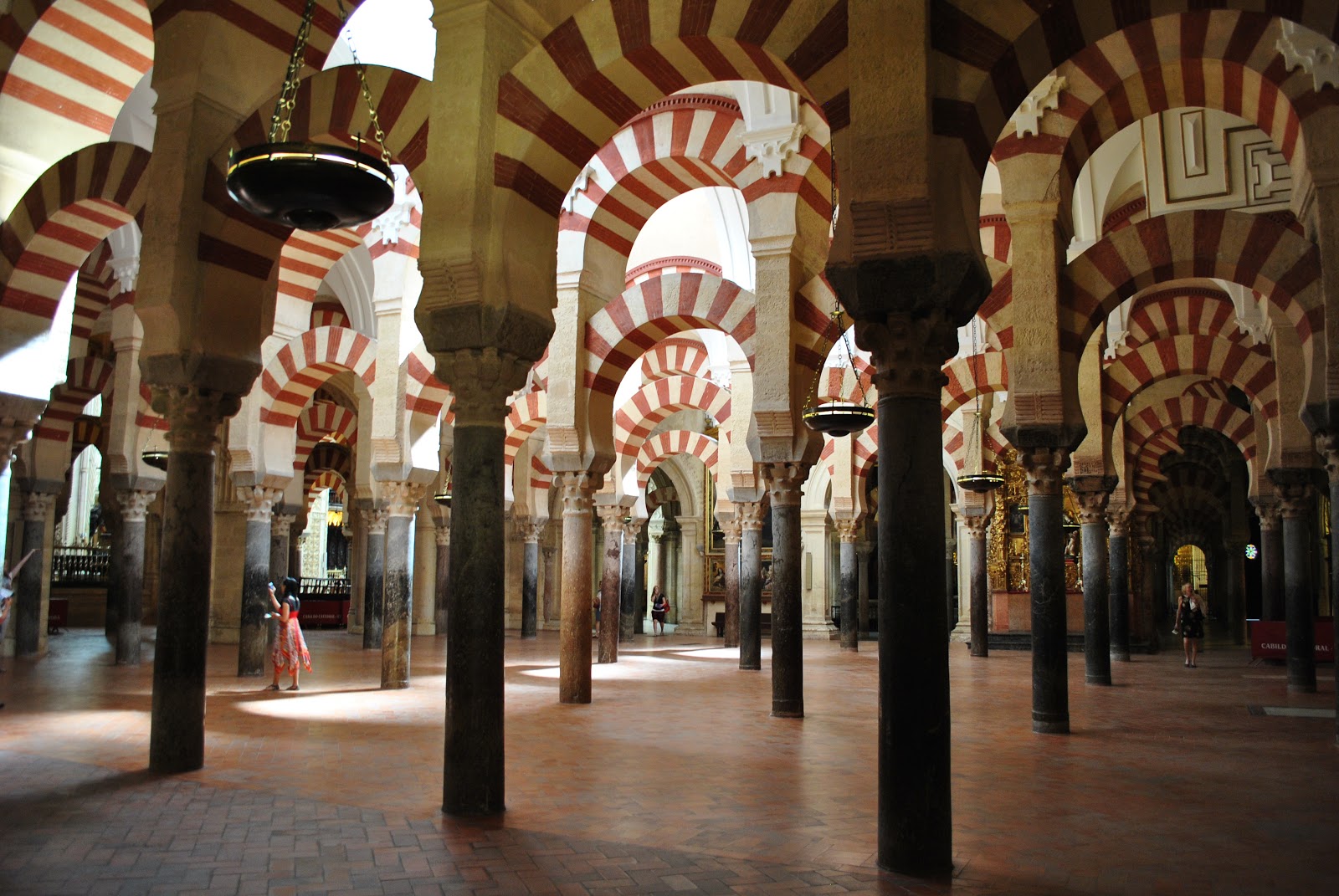
Córdoba was the capital of the Islamic caliphate that ruled Spain and parts of North Africa from 929 to 1031, but it was a thriving city long before that. It also existed in Roman times, hence the 2000-year-old bridge we crossed to get to La Mezquita de Córdoba. This mosque is one of the most famous in the world. I’ve heard it be called the “palm tree” mosque because the painted arches inside look like a forest of palm trees. This building is incredible. It is huge: the size of four football fields. I could easily get lost inside, even though it’s mostly one big room. Before becoming a mosque, the original building, which was much smaller, was a Roman temple and then a Visigothic church. In the 700s, it was converted into a mosque, and in 987, it reached its current dimensions. Today the mosque is a Catholic cathedral. After the Reconquista in the 1200s, it was converted back to a church, and in the 1500s, a cathedral nave was inserted right in the middle of the building.


 |
| Cathedral nave in the center. |
One of the most impressive features of the mosque is its Mirhab, the sacred alcove where the Quran is kept. This particular one is entirely a mosaic, but you can’t tell it’s a mosaic, since the tiles are so tiny. Italian artists, such as Michelangelo, came to study this amazing work of art.


We also wandered through the original Jewish part of the city. The Muslim empire was pretty tolerant and allowed Jews and Christians to live in the cities in peace, although they generally paid higher taxes. We visited a synagogue, which shows the blending and harmony of the three cultures. It is a Jewish synagogue, designed using Islamic architecture, and was eventually used as a Christian church.


At the end of our tour, we had about an hour of free time, so some of us went to check out la feria. Every May, for about a week, Córdoba has this big fair. To me, it looked like the equivalent of the county fair up in Coeur d’Alene, except there were lots of girls and women dressed in Flamenco dresses. Apparently, there is dancing every day as well. It had such a great atmosphere. There were rides, animals, candy booths, and games. So fun.


We rolled into Sevilla around 9:00 PM. Our next task was to find dinner. We walked for 30 minutes to find this restaurant, but it was well worth the walk. Everything was all set up and ready to go, so we had very quick service. I don’t know if it was just because I was starving, but the food was really good. I tried duck liver. It tasted like tuna (chicken of the sea), and I actually liked it. The main course was paella. Seafood paella. Oh, sweet paella. It was amazing. Like I said, worth the walk.
Fast forward to the next morning. It was quite lovely waking up in Sevilla, especially because breakfast wasn’t until 10:00. It’s a beautiful city spanning across the Guadalquivir River and is the capital of Andalucía. Columbus lived and studied here, and Ponce de Leon (Pirates 4, anyone???), discoverer of Florida, lived here.

 |
| Eye candy. :) |
Our tour in Sevilla consisted of a palace and a cathedral. Our first stop was the Real Alcázar de Sevilla, built in the 14th century and Europe’s oldest palace in use (remember, an alcazar is a castle that belongs to the king). The upper floors are still used by the Royal Family. This palace was built for Catholic kings, but as you can see from the pictures, it was designed completely by Muslims. My kind of palace. In addition, there were beautiful gardens attached, which were home to three peacocks! That was cool. We could get really close, since they aren’t penned in, without scaring them. I’m sure they’re very used to people by now.


La Catedral de Santa Maria is the largest cathedral in the world and the last gothic cathedral to be built in Europe. Construction began in 1402 and work was still being done into the 1900s, although the cathedral was finished for the most part in 1519. The tower and the patio are part of the original mosque that used to stand in its place. That’s a reoccurring theme with many of these ancient structures. Instead of destroying the original buildings, even if they belonged to other religions or cultures, many people decided to use what was there and convert them to serve other purposes. Looks like they realized the importance of recycling long before we did. So part of Columbus’ remains are buried in this cathedral, specifically his head, upper torso, and right arm and hand (they’ve done DNA testing to be sure it is really him). He was originally buried somewhere else in Sevilla, then moved to Santo Domingo and then Cuba. I guess parts of him have been lost along the way, or maybe purposefully left in those places. I think the coolest part of the cathedral was getting to climb the tower, known as the Giralda. We climbed up 35 floors of ramps (they used ramps so horses could take you to the top) and then some stairs. The view was incredible. As you walk around you get a full 360 degree view of all Sevilla, and what a view it was.


The rest of the afternoon was spent wandering through the city, specifically the old Jewish quarter, looking through the shops. Erin and Spencer wanted to find some fans for gifts. I bought a little, simple one too, because that’s the cool thing to do in Spain. You’ve got to have a fan.

To finish out the day we went to a flamenco bar. Oh my gosh. It was easily one of the most amazing things I’ve ever seen. I cannot comprehend how their hands do not get tired from all the clapping, and how the dancers’ feet move as fast as they do, and how they coordinate their hands and feet the way they do. Wow. And the male flamenco dancers? Soooooo attractive. I will take one of them, please. Needless to say, it was a good night.
 |
| Left, center, right. Our hott flamenco buddies. |
Before leaving for Granada the next morning, we stopped at La Plaza de España. Why did we stop there? Because it’s where they filmed a scene in Star Wars: Episode II! It’s the scene where Anakin and Senator Amidala arrive back on Naboo. Click here to watch the clip (it’s even in Spanish!). I’m not ashamed to admit that I was definitely really, really excited. It’s not every day you get to feel like you’re in one of your favorite movie series.


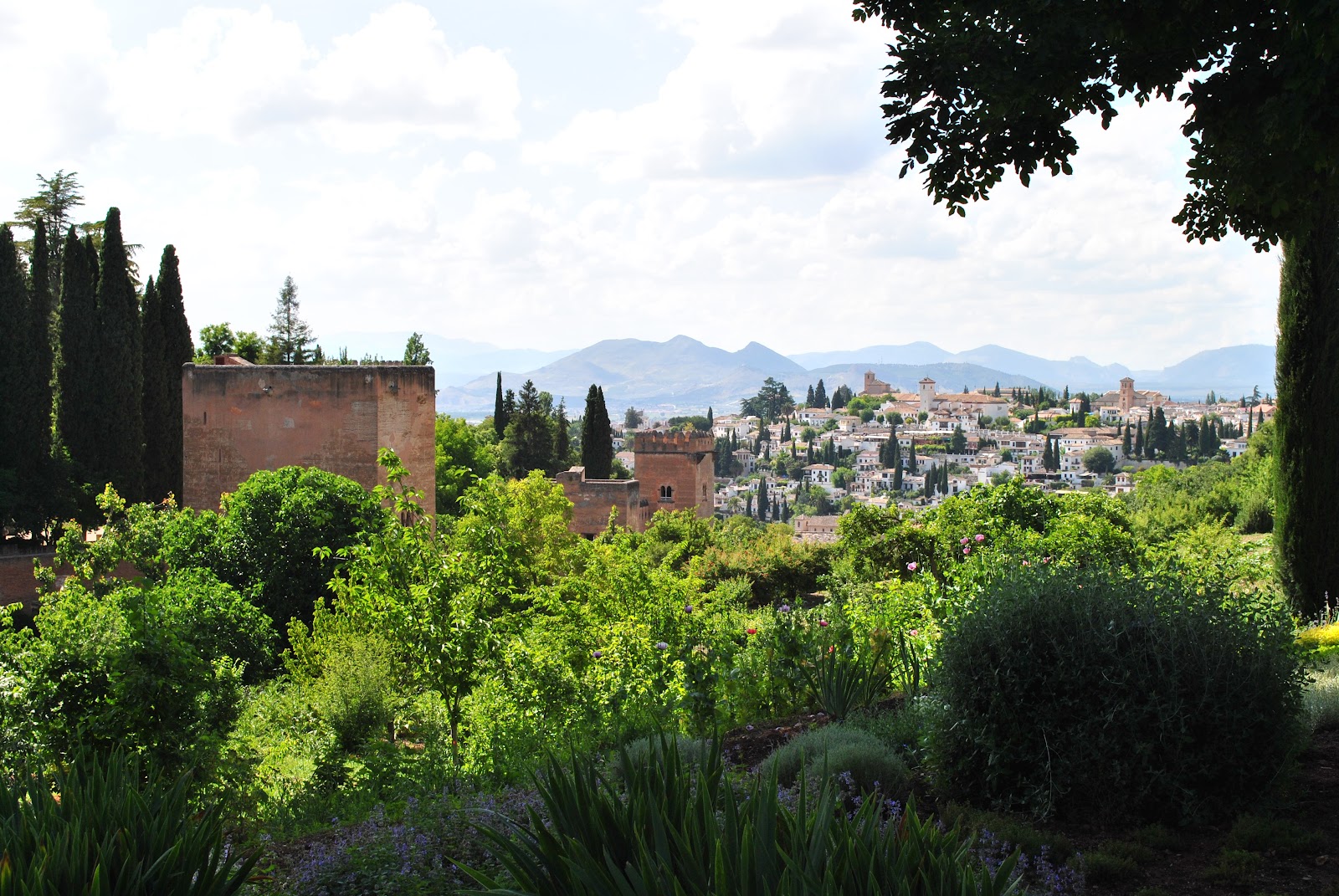
So in Granada (fun fact: granada means pomegranate in Spanish) we went to see La Alhambra. Technically, La Alhambra, which means “red fortress,” is a city of its own and people still live there today. It is a walled enclosure filled with palaces, gardens, and a little town. It was founded in the 13th century and remained the capital of the Moorish empire for the last 300 years of Islamic rule. It was also the capital of Spain after the Reconquista, until Felipe II moved it to Madrid. La Alhambra includes the famous Generalife gardens, which includes their own separate palaces. Generalife refers to the more rural part, while La Alhambra refers to the urban part, although both are included within the walls.
 |
| Palacio de Leones - Charles V |
 |
| Nasrid Palaces |

We topped off the night by going to an Indian (like from India) market. I successfully bartered for a cute bag and saved myself 3 euros! Not gonna lie, I felt pretty cool.
The next morning, we only made one stop before heading back to Alcalá: La Casa Natal de Federico Garcia Lorca, or the childhood house of Lorca. He is a famous Spanish playwright who wrote “Bodas de Sangre,” which happens to be the flamenco play we saw in El Real Teatro. Really, I probably could have gone without stopping here. It would have been neat if I were a fan of his works, but I’ve only seen an adaptation of one of his plays. Eh, not everything has to be exciting. I just hope it was exciting for at least one person.
I definitely place my stamp of approval on southern Spain. It’s been wonderful, although I would recommend at least two days in each city. There’s so much more I wanted to see! I guess that means I’ll just have to come back. Darn it. :)


